



Monmouth University
President’s Report
2025
Table of Contents
- From the President
- Strength, Built Over Time
- Opportunity, By Design
- Discovery, That Delivers
- Where Place Shapes Possibilities
- Monmouth Earns National University Designation
- At the Forefront of Coastal Science
- A Permanent Home Takes Shape
- Faculty & Student Achievement
- New & Noteworthy
- University Leadership
- Financials

From the President
Dear Friends:
hen Monmouth University opened its doors in 1933 as a two-year junior college offering night classes to local students, no one could have fully anticipated what this institution would become. Nearly a century later, I am proud to report that Monmouth has earned designation as a National University—recognition that reflects not a single moment, but the results of sustained, purposeful work across every corner of this campus. The pages that follow document that progress and highlight milestones from a year of exciting momentum here at Monmouth.
In 2025, we enrolled the most academically prepared class in our history—and simultaneously enrolled the highest-ever percentage of first-generation and/or low-income students. More than 40% qualified for Pell Grant support. And, this same class posted record-high GPAs, record SAT scores, and our largest-ever Honors School enrollment. This first-year class profile underscored the idea that excellence and access are not competing values—something Monmouth continues to prove year after year.
Our Carnegie Research College and University designation—placing us among the top 14% of American institutions for research activity—reflects a parallel story. We did not simply declare ourselves a research university. We built one, through faculty scholarship, student-faculty collaboration, and applied inquiry that serves our local and regional communities well beyond our campus. The Urban Coast Institute, now entering its third decade, exemplifies that commitment: translating rigorous science into policy and generating innovative research opportunities for students along the way.
Strength,
Built Over Time
ounded in 1933 as Monmouth Junior College, a two-year institution created to expand access when opportunity was limited, the University has grown with purpose. Nearly a century later, Monmouth stands as a comprehensive private institution where academic excellence and expanded access are not competing priorities, but enduring commitments.
Strength, Built Over Time
ounded in 1933 as Monmouth Junior College, a two-year institution created to expand access when opportunity was limited, the University has grown with purpose. Nearly a century later, Monmouth stands as a comprehensive private institution where academic excellence and expanded access are not competing priorities, but enduring commitments.
National Standing Earned
Debt-Free by Design
Investment That Matches Ambition
Competing on a National Stage
A Landmark Academic Investment


Opportunity,
By Design
ounded on the belief that higher education should expand opportunity, Monmouth today pairs rising academic strength with unprecedented socioeconomic diversity. As the University grows its national profile, it offers a compelling model for redefining what private higher education can be.
Excellence Without Tradeoffs
Pell Access Expanded
From Access to Achievement
Advancing Social Mobility
Discovery, That Delivers
ustained investment in faculty scholarship, student research, and applied innovation has strengthened Monmouth’s role as a driver of discovery. Across disciplines, inquiry is translating into solutions that serve communities and inform public policy.
Carnegie Research Designation Earned
Centers and Institutes Driving Impact
Research in Motion Along the Coast
Innovation Recognized by Peers
Where Place Shapes Possibilities
ituated less than a mile from the Atlantic Ocean and within easy reach of two major metropolitan centers, Monmouth integrates place directly into the student experience. Coastal ecosystems, urban industries, and regional cultural institutions serve as practical extensions of the classroom.
Historic Grounds, Modern Learning
Connected to Major Markets
A Region That Fuels Creativity

Monmouth Earns National University Designation
onmouth University has been designated a National University by U.S. News & World Report, marking a milestone in the institution’s long-term academic evolution.
The designation reflects Monmouth’s expanded academic scope, increased research activity, and the breadth of its undergraduate, graduate, and doctoral programs. While the University has long advanced beyond a regional profile, this new classification formally recognizes that progression on a national scale.
“Monmouth’s story has always been about mission-driven academic excellence and continuous improvement,” President Patrick F. Leahy said. “From our founding in 1933 as a junior college offering night classes, to a comprehensive university with national reach, this designation affirms the steady, intentional work of generations of faculty, students, staff, alumni, and trustees.”

At the Forefront of Coastal Science and Public Impact
ast October, the Urban Coast Institute (UCI) at Monmouth University welcomed national leaders in ocean science, technology, and public policy to campus for its signature event, the Future of the Ocean Symposium and Champion of the Ocean Awards Luncheon. Held in the University’s Great Hall, the program examined how emerging technologies and scientific innovation are reshaping ocean research, environmental stewardship, and national security.
The event also marked a milestone. As the UCI celebrated its 20th anniversary year, the symposium and awards illustrated the Institute’s evolution from an organization that began with a single full-time employee to a leading hub for applied coastal and ocean research, policy engagement, and student opportunity. Today, it is supported by a multidisciplinary team of a dozen professionals.
A Permanent Home Takes Shape
s construction advanced on its 30,000-square-foot permanent home, the Bruce Springsteen Center for American Music marked 2025 with record-setting programs, major exhibitions, and milestone anniversaries that drew audiences from across the country and around the world to campus.
Highlights included a multiday celebration of the 50th anniversary of “Born to Run,” a sold-out American Music Honors ceremony that raised more than $1 million to support the Center’s work, and a traveling exhibition that continued its national tour. Scholarly outreach expanded as anticipation built for the Center’s permanent home, which is scheduled to open in June.
Together, these efforts reflect the Center’s growing role in preserving and advancing the study of American music across genres and generations, using Springsteen’s work as a gateway to the broader story of the nation’s musical traditions.
Faculty & Student Achievement

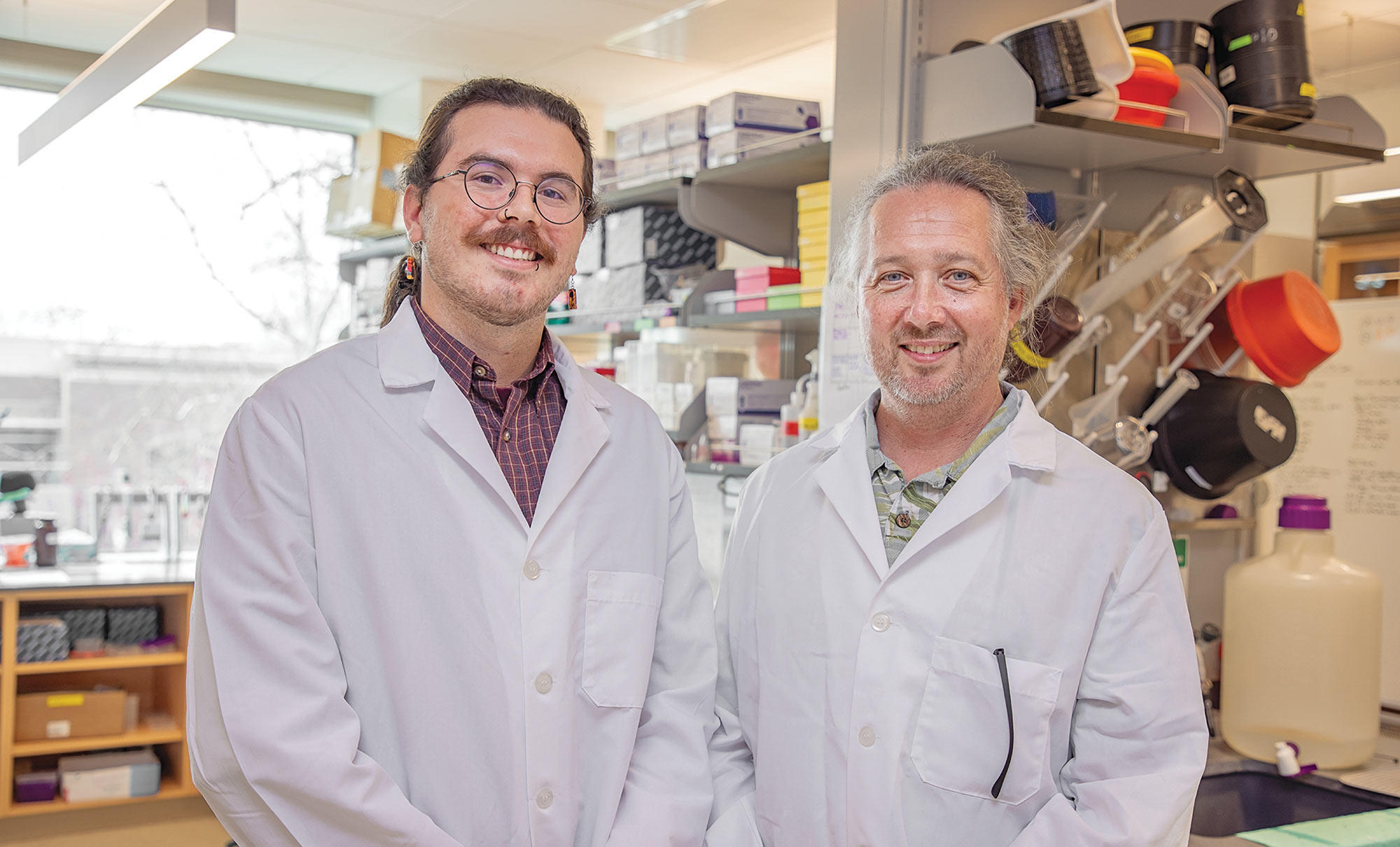
Monmouth Researchers Confirm First U.S. Discovery of Invasive Species
ason Adolf, Ph.D., endowed professor of marine science, and senior marine and environmental biology and policy student Diederik Boonman Morales confirmed the first documented presence of an invasive species—the beadlet anemone (Actinia equina)—along North American shores.
Boonman Morales first encountered the anemones while cataloging intertidal life near campus in Adolf’s marine biology class. The species typically inhabits the rocky coastlines of the British Isles and northern Europe, making its appearance on New Jersey’s human-made groins (aka jetties) both unexpected and surprising given its usual range. After the initial sighting, the team located additional anemones across jetty systems from Long Branch to Manasquan.
New & Noteworthy
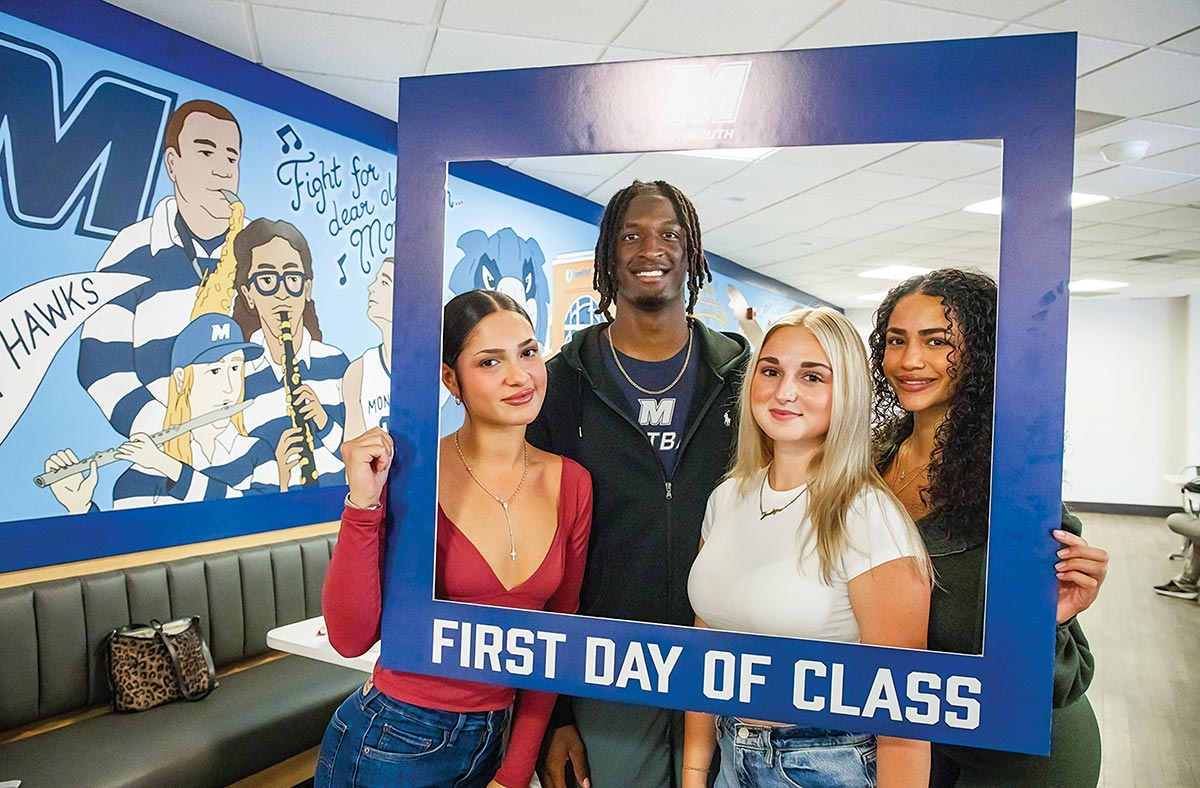
First-Year Class Sets New Benchmarks for Excellence and Access
ast fall’s incoming class was the most academically prepared in Monmouth University’s 92-year history, while also setting new benchmarks in key measures of access.
The Class of 2029 posted the highest average GPA (3.67), the highest submitted SAT scores (1225), and the largest Honors School enrollment (126 students) of any first-year cohort to date. At the same time, the class includes a record number of students who joined Monmouth’s thriving first-generation and/or low-income community, representing 55.8% of the first-year class. First-generation students make up a record-high 41.3% of the cohort, while 40.8% of incoming students are Pell Grant–eligible—the highest percentage in University history.

University Leadership | 2025†
Andrew Brannen
Vice President and Chief Business Officer
Charlene K. Diana, Esq.
Vice President and General Counsel
Amanda Klaus ’09
Vice President for University Advancement
Robert D. Mc Caig, Ed.D.
Vice President for Enrollment Management and Marketing
Emily Miller-Gonzalez, J.D.
Chief of Staff
James Pillar, Ed.D.
Vice President for Student Life
Zaneta Rago-Craft, Ed.D.
Director, Intercultural Center; Advisor to the President on Diversity and Inclusion
Jennifer Sansevero, J.D.
Director of Athletics
Richard Veit, Ph.D.
Provost and Senior Vice President for Academic Affairs
Shannon Clifford, Ph.D.
Acting Dean, Marjorie K. Unterberg School of Nursing and Health Studies
Joseph Coyle, Ph.D.
Dean, School of Science
David Hamilton Golland, Ph.D.
Dean, Wayne D. McMurray School of Humanities and Social Sciences
Amy Gratch Hoyle, Ph.D.
Dean, School of Education
Golam M. Mathbor, Ph.D.
Interim Dean, School of Social Work
Nancy Uddin, Ph.D.
Interim Dean, Leon Hess Business School
Christopher D. Maher, Chair
Leslie N. Hitchner, Vice Chair
Tasha A. Youngblood Brown ’97, ’03M, Vice Chair
Stephen E. Gerard ’89M, Treasurer
Dean Q. Lin, FACHE, Secretary
Charlene K. Diana, Esq., Assistant Secretary of the Board (Ex officio)
Miles J. Austin III ’19
Michael V. Benedetto, Esq. ’90
John C. Conover III
Karyn F. Cusanelli ’89
Regina M. Foley ’89
Jeremy Grunin
Harold L. Hodes ’65
Kanesha K. Jones ’03
Raymond G. Klose ’77
Mari C. Kovach ’82, ’86M
Adam G. Kraushaar
Patrick F. Leahy, Ed.D. (Ex officio)
Nancy A. Leidersdorff ’97
Alaina L. Love ’79
Lisa McKean
Valerie Montecalvo
Bayaan A. Oluyadi ’13 (Ex officio)
David A. Reale ’96
Gregory Seaman ’99
Rocio F. Serey ’16
Christopher W. Shaw
Carol A. Stillwell
Stanley S. Bey ’59
Thomas D. Byer ’67
Alan E. Davis, Esq.
Judith Ann Eisenberg
Alfred L. Ferguson, Esq. ’13HN
Frederick J. Kaeli, Jr. ’61
Henry D. Mercer, III ’87, ’17HN
Stephen M. Parks ’68, ’07HN
Charles T. Parton ’01HN
Jeana M. Piscatelli ’01, ’02M
Michael A. Plodwick ’82
Thomas A. Porskievies ’82, ’86M
Steven J. Pozycki ’73
William B. Roberts
Robert B. Sculthorpe ’63, ’15HN
John Comiskey, Ed.D., Chair
Associate Professor, Department of Criminal Justice
Lu-Ann Russell, Chair
Senior Director of Conference Services and Special Events
Brendan Sheehan, President
† As of Dec. 31, 2025
Financials
Council of Independent Colleges Fiscal Year FIT Score
he University annually reviews the Council of Independent Colleges’ Financial Indicators Tool (FIT) to assess the University’s financial health over time as well as compared to similar institutions. The FIT score presents a complete picture of an institution’s financial strengths and weaknesses and is a useful strategic indicator for institutions at various levels of financial health. The University’s FIT score is a measure of its overall financial strength based on the sufficiency and flexibility of resources, the management of debt, the performance of assets, and the results of operations. The FIT score falls along a scale of -4.0 to 10.0, and a score of 3.0 is the threshold of institutional financial health. For the past five years, the University has continued to exceed the 3.0 threshold with an average score of 6.4.

Investment Market Value as of June 30 ($ Millions)

Outstanding Debt as of June 30 ($ Millions)

Investment Market Value as of June 30 ($ Millions)
Outstanding Debt as of June 30 ($ Millions)

President’s Report