


 Bruce Springsteen Archives and Center for American Music
A Landmark Year
he Bruce Springsteen Archives and Center for American Music celebrated a year of milestones in 2024, from breaking ground on its future home at Monmouth University to honoring music icons and launching a lecture series exploring the intersection of music and history.
Breaking Ground on a Legacy
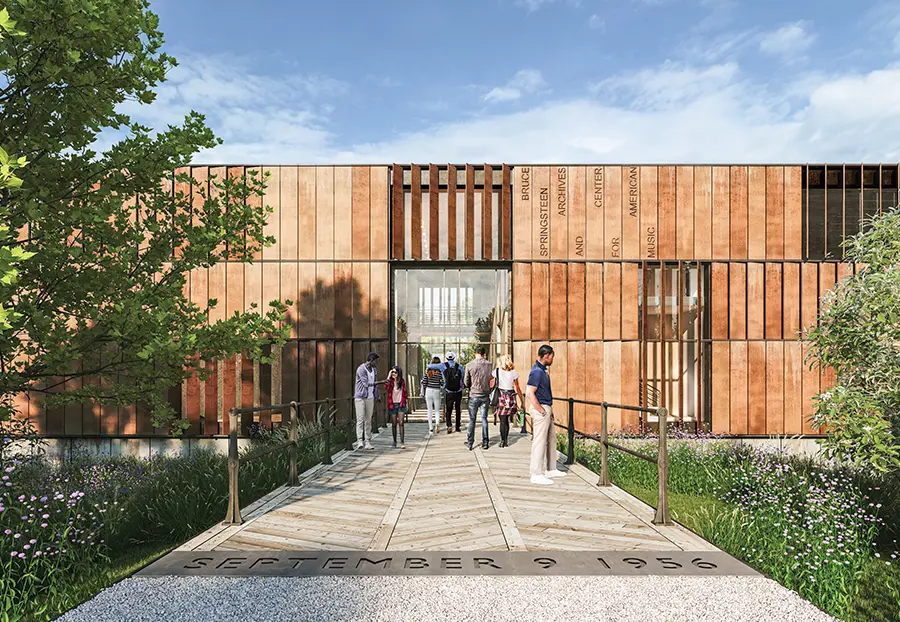
Situated on campus not far from where Springsteen wrote “Born to Run” 50 years ago, the facility will house the Archives, the Center for American Music, interactive exhibition galleries, and a 244-seat, state-of-the-art theater.
Scheduled to open in 2026, the $48 million project will be entirely funded by external donors and designed with sustainability in mind. By the end of 2024, nearly 75% of funding had been secured—including a multimillion-dollar commitment from the state of New Jersey backed by Gov. Phil Murphy and key legislators—giving the project strong momentum heading into its next phase.
Once complete, the center will offer a dynamic experience, featuring interactive exhibits on Springsteen’s career, rare film footage, oral histories, and major moments in music history. The venue will also host intimate concerts, educational workshops, and public programs designed to engage students, teachers, and music lovers alike.
On March 6, 2025, University and Archives leadership, alongside partners from Torcon Inc. and CookFox Architects, celebrated a major milestone—the placement of the final steel beam. Project leaders and key members of the Monmouth team signed the beam before it was lifted into place, symbolizing the University’s commitment to preserving America’s musical legacy.
Honoring American Music Icons
Mellencamp was honored for his social activism, which is reflected in both his music and his role in co-founding Farm Aid, an organization that addresses the struggles of American family farmers. Browne was recognized for his long-standing advocacy for social justice, environmental causes, and educational initiatives. Staples was celebrated for her role in the civil rights movement of the 1960s and her continued efforts to promote racial equality through music. DiMucci was honored for his landmark recording of “Abraham, Martin and John,” an anthem of activism in the late 1960s.
Hosted by former “NBC Nightly News” anchor Brian Williams, the event featured remarks from Gov. Murphy and award presentations by Springsteen, Steven Van Zandt, Darlene Love, and Jon Landau. The evening ended with a high-energy jam session featuring the honorees and presenters.
Together with a silent auction, the event raised more than $1 million to support the Archives’ operations.


Music as a Catalyst for Change
In his lecture, “Mercy Mercy Me (The Ecology): Long Sixties Protest Music and the Earth Day Revolution,” Brinkley highlighted music’s integral and enduring role in the environmental movement. He traced the rise of environmental activism from Theodore Roosevelt and Franklin D. Roosevelt’s policies to the cultural movement sparked by Rachel Carson’s “Silent Spring” in 1962, which galvanized artists such as Joni Mitchell.
President Patrick F. Leahy noted that the lecture “showcases the center’s mission to educate and inspire future generations to understand the diverse influences in American music and appreciate its power as a force for change.”
“Music America” Exhibit Premieres
For the first time in one place, visitors could see B.B. King’s guitar, Lucille; Billie Holiday’s fox fur stole; Elvis Presley’s handmade velvet shirt; Chuck D’s handwritten “Fight the Power” lyrics; Springsteen’s “Born in the U.S.A.” outfit; and a guitar played by Taylor Swift, along with a costume from her Reputation tour. Visitors could also explore an interactive Song Bar, where they listened to featured artists and experienced the evolving sounds of American music.
“So much of America’s greatest music history occurred in the 1960s when President Johnson was in the White House. It seemed only natural to launch this exhibition in Austin, one of the country’s most important music centers, before it travels to other presidential libraries and museums,” said Robert Santelli, founding executive director of the Archives.

